

DP World Tour faces title sponsor scrutiny after Epstein file disclosures
No tournament this week. No place to hide, either. The DP World Tour is now caught in the reputational undertow of the latest Jeffrey Epstein disclosures...

No tournament this week. No place to hide, either. The DP World Tour is now caught in the reputational undertow of the latest Jeffrey Epstein disclosures, because its title partner’s chairman and chief executive have been publicly named and linked to reported email correspondence with Epstein, and it is not good reading at all.
The victims at the centre, and golf’s reputational bind
Epstein’s name is not a normal scandal marker. It is shorthand for years of documented sexual abuse, grooming and exploitation, and for the institutional failures that allowed it to continue. The public record is full of survivors’ accounts and civil actions that describe a system designed to recruit, isolate and control young women and girls. Any fresh disclosure that re-opens the Epstein orbit lands differently for that reason: it is not a reputational spat between powerful men. It is, first, a reminder of victims whose lives were upended, and whose credibility was too often treated as optional.
That reality is the DP World Tour’s dilemma. The Tour cannot treat this as background noise because its title partner is not just a logo on a leaderboard, it is the brand on the building. When the sponsor’s chief executive is pulled into the Epstein file cycle, silence risks looking like indifference to what Epstein represents, while overreach risks misstatement in a legally charged story. The only workable route is clarity: acknowledge the victims at the centre of the Epstein case, separate allegation from evidence, and state what standards apply when the Tour’s own title sponsor is under scrutiny.
The DP World Tour’s commercial identity is built around its title partner. That is not a slogan. It is the Tour’s name, its flagship season narrative, and the centrepiece of its Race to Dubai calendar.
That is why the Tour is now exposed after Sultan Ahmed bin Sulayem, chairman and CEO of DP World, was publicly identified in connection with unredacted Epstein-related files reviewed at the US Department of Justice.
On 10 February 2026, US congressman Ro Khanna disclosed six previously redacted names during a House floor speech after he and Republican congressman Thomas Massie said they had viewed unredacted documents at the DOJ. Bin Sulayem was one of the names read into the record. The Guardian reported that Khanna did not provide evidence of wrongdoing against any of the individuals he named, and that none have been charged in connection with Epstein.
What is being reported about bin Sulayem and Epstein
The story has moved beyond casual name-checks. Major outlets have reported on emails involving bin Sulayem and Epstein, citing DOJ-related releases.
The Financial Times reported that bin Sulayem maintained contact with Epstein years after Epstein’s 2008 conviction, and that their correspondence included explicit content and discussion of women. The FT described exchanges that include sexual boasting, nude images and discussion of escorts and prostitution, including what it called a prostitution “price list”.
Bloomberg Law has also described extensive exchanges over time, citing DOJ-released emails and other material obtained by Bloomberg, portraying a relationship that mixed crude personal content with practical, day-to-day arrangements rather than a distant or incidental link.
The FT further reported an email thread in which bin Sulayem helped arrange for a Russian “masseuse” linked to Epstein’s “private spa” to train in Turkey, as requested by Epstein, again citing DOJ-released emails.
Those dynamics are reinforced by documents circulating in the DOJ “Epstein Library” release, including excerpts reviewed by Par and Paddock. The emails show invitations to dine at Epstein’s Manhattan townhouse and follow-up exchanges that read as familiar and routine.
The releases also show activity that goes beyond socialising. A 2017 chain titled “Re: Wiring instructions” includes a message from bin Sulayem stating, “Ok the amount is $6084.95,” along with requests for wiring instructions. Reporting based on the same tranche of DOJ-released emails says the payment related to an attempt to purchase more than two dozen 23andMe DNA kits for bin Sulayem, an unusually large order that prompted compliance questions at the company; the same reporting says Epstein’s assistant had also bought several kits earlier via Amazon, with paperwork framed around reimbursement.
DP World’s position on the substance of these reports matters because the Tour’s brand is inseparable from the sponsor. A sponsor’s corporate crisis quickly becomes a Tour crisis.
The “torture video” allegation: what is known and what is not
This is the most inflammatory claim circulating, and it is where precision matters most.
The Guardian reported that Thomas Massie said that once names were unredacted, it “appears” DOJ effectively confirmed bin Sulayem was the recipient of an email from Epstein in which Epstein wrote: “I loved the torture video.”
What that does not establish, based on the reporting:
It does not confirm what the “torture video” was, whether it existed as described, or its content.
It does not confirm that bin Sulayem sent a video, or that he distributed anything.
It does not prove wrongdoing by a recipient because an email line exists.
At present, the “torture video” line is best described as a lawmaker’s claim about an email phrase and the identification of a recipient, reported by mainstream media, not a verified account of who sent what, or proof of criminal conduct.
That distinction is crucial. It is also easily lost in public debate unless DP World and the Tour address the issue directly.
Why this becomes a DP World Tour problem
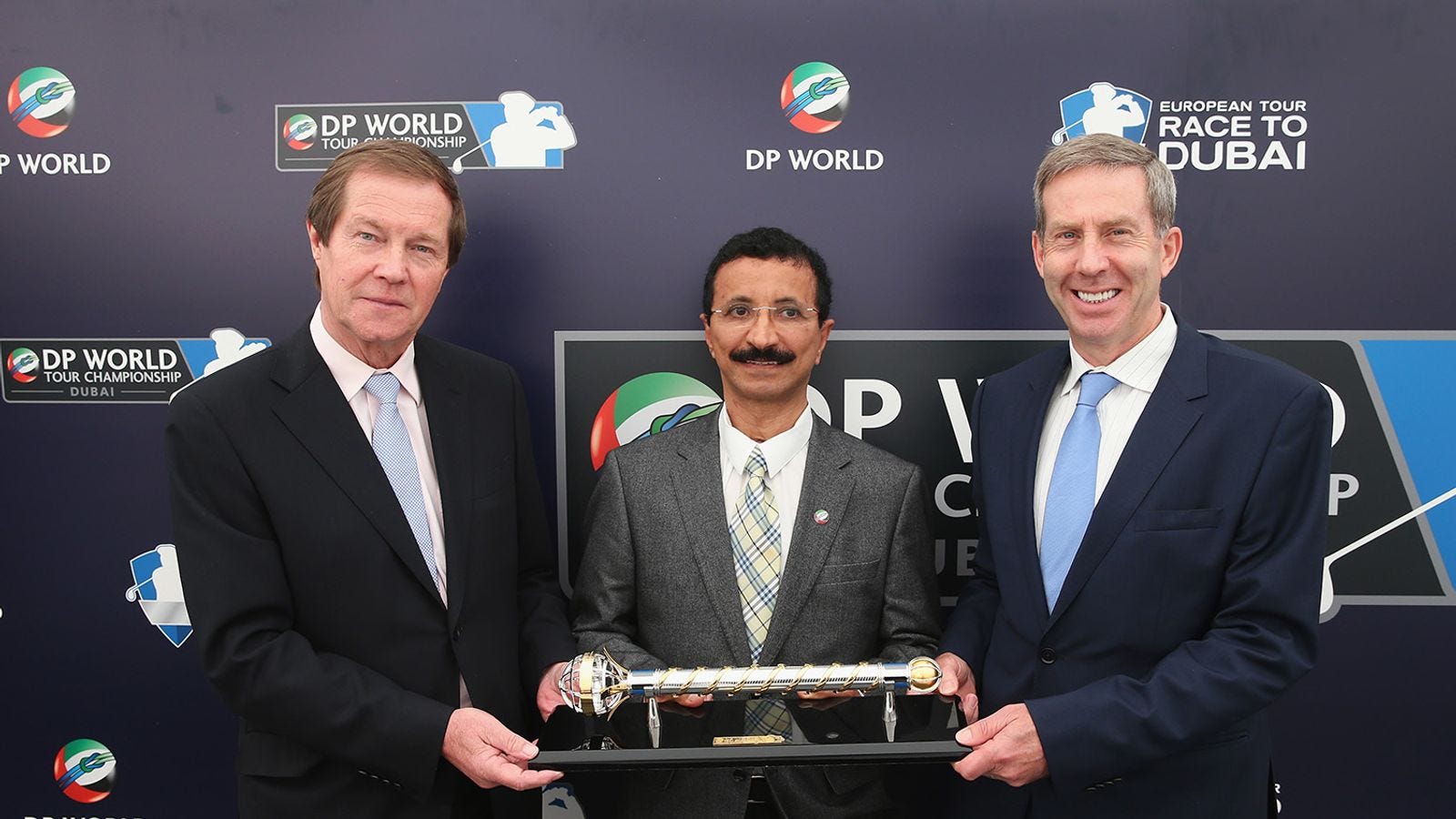
DP World is not a background partner. It is the title partner under a deal extended to 2035, described by the Tour as the largest partnership agreement in its history.
That creates three immediate pressures:
Sponsor ecosystem risk: secondary partners and hospitality clients do not want adjacency to an Epstein-related scandal cycle, regardless of legal outcomes.
Player and broadcast exposure: golfers may be asked about it in press rooms and mixed zones, especially during the UAE swing and the season-ending Race to Dubai weeks.
Leadership credibility: the Tour will face questions about whether it has sought assurances, and whether it is comfortable fronting a season branded around DP World while the sponsor’s chairman and chief executive is under scrutiny.
The Tour does not need to decide guilt or innocence. But it needs to demonstrate an understanding of reputational exposure and basic governance instincts.
What a statement should say, and why silence is risky
A smart response from the DP World Tour would be procedural, not theatrical:
confirm awareness of the reporting;
confirm it has sought clarification from its title partner;
restate governance and safeguarding expectations;
refuse to speculate on unverified claims.
DP World, meanwhile, is under greater pressure because this falls on leadership. A credible corporate statement would typically cover:
the nature and timeframe of any contact with Epstein;
a clear denial of any wrongdoing, if that is DP World’s position;
governance steps taken (board oversight, external counsel, internal review);
transparency within legal limits.
Silence is a strategy when a story lacks traction. This one does not. It is now mainstream, linked to DOJ-related disclosures, and tied to the public naming of individuals by U.S. lawmakers.
The bottom line
No one named by Khanna has been charged in connection with Epstein, and Rho Khanna did not provide evidence of wrongdoing when he read the names into the record.
But the DP World Tour cannot treat this as someone else’s problem. Its title partner’s chairman and chief executive is now a subject of significant public scrutiny, and credible reporting has described emails and actions that will raise questions among sponsors, players and fans.
This is exactly the sort of reputational risk a global sports property must manage fast, because once the narrative hardens, it stops being a “story” and becomes part of the brand.