

OWGR finally lets LIV in, but with a hard ceiling that changes everything
OWGR has opened the door to LIV Golf at last. From the 2026 season, LIV’s individual stroke-play events will award Official World Golf Ranking points....

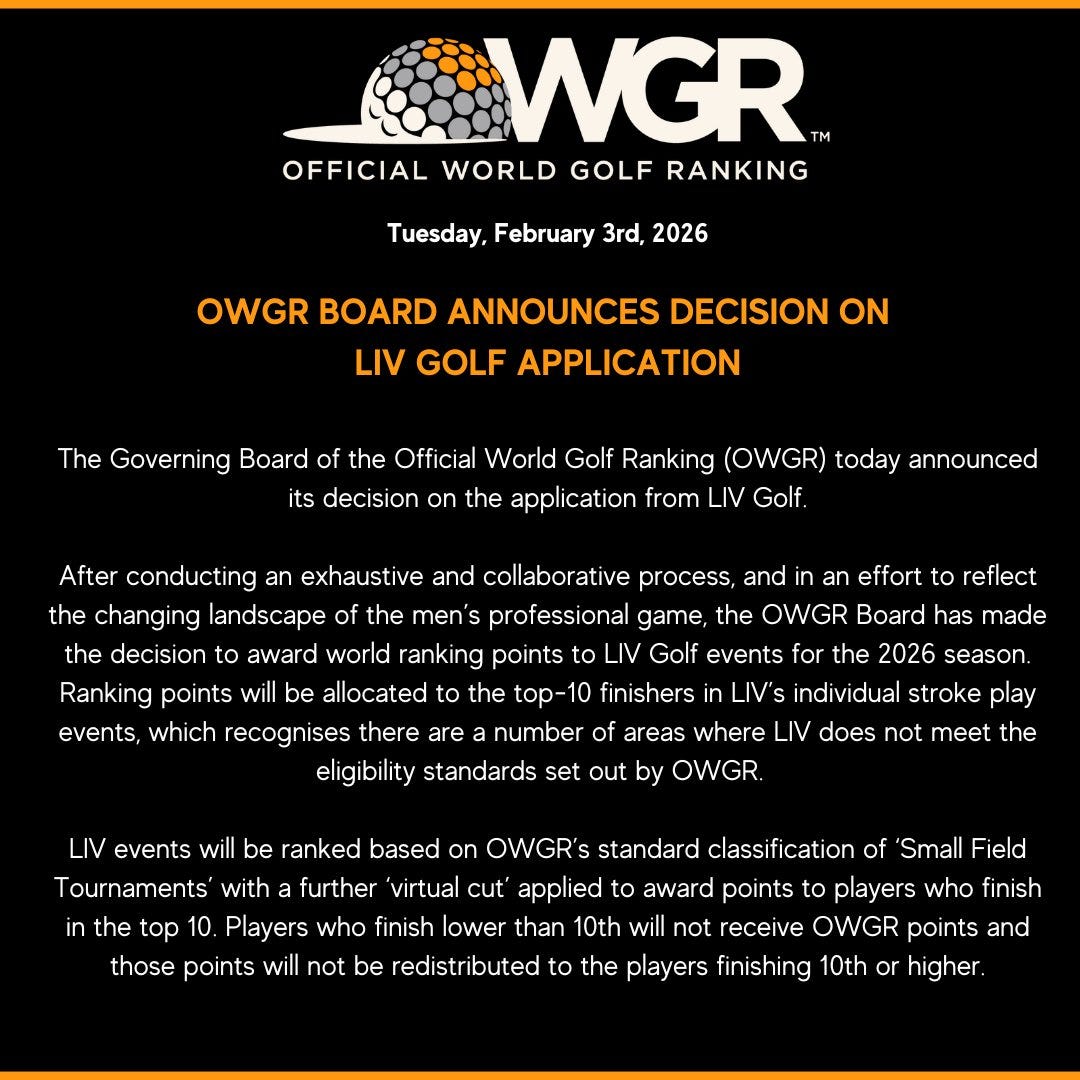
OWGR has opened the door to LIV Golf at last. From the 2026 season, LIV’s individual stroke-play events will award Official World Golf Ranking points — but only to the top 10 finishers (and ties). Everyone else gets zero, and the unused points won’t be redistributed up the leaderboard.
That’s the headline. The subtext is sharper: OWGR is granting recognition that LIV remains structurally “different”, and, in key areas, short of the eligibility standards OWGR applies to other tours.
The result is a compromise with teeth. LIV gets OWGR points at last, but the top-10-only rule makes every event more ruthless: you’re either in the points, or you’ve effectively wasted the week in ranking terms.
What OWGR has actually approved
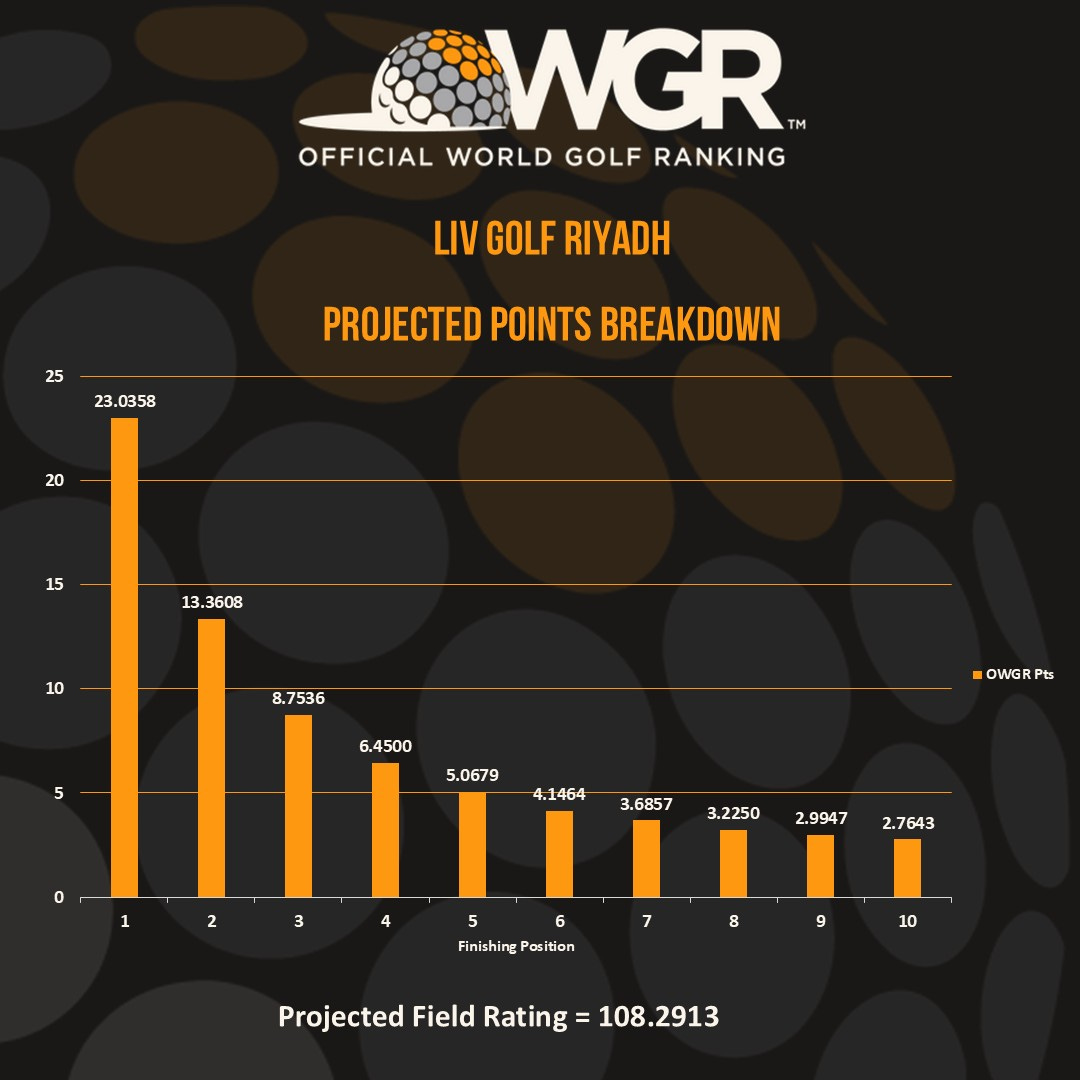
OWGR’s decision applies to LIV’s individual stroke-play tournaments in 2026. They will be treated as “Small Field Tournaments”, and points will be awarded only through 10th place and ties. Players outside the top 10 will receive no OWGR points, and the system will not reallocate those “missing” points to players above 10th.
This matters because LIV has been operating in a rankings vacuum since launch. Now, its best performers can finally earn world ranking points, but OWGR has put a hard cap on how much LIV results can move the needle.
The “disparity” that fans will notice, and why it’s real
On OWGR’s explainer pages, the general framework states that ranking points are awarded across the field, and even in no-cut events, the standard approach is to zero out only the bottom 15% (unless an exception applies).
So why does LIV get only the top 10?
Because OWGR is explicitly using its discretion to apply a cut-off adaptation. In the announcement language, the top-10 limit is not framed as the normal rule; it’s the price of inclusion given LIV’s format and governance differences, including small fields (LIV’s 2026 field is 57), no-cut history, and “restrictive pathways” into the league.
In plain terms, OWGR is saying, we’ll count you, but not like everyone else.
Relegation has expanded. That’s the other half of the squeeze.
LIV has made a significant competitive shift for 2026. The league has confirmed a season-long structure that formalises pressure at the bottom end of the table:
Lock Zone: 1–34 (safe)
Open Zone: 35–46 (not fully secure)
Drop Zone: 47–57 (relegation — 11 players lose their place)
That’s a major ratchet. Roughly one-fifth of the league is now exposed to relegation pressure across every season.
So LIV players are being pinched from both ends:
Top end: only top 10 and ties earn OWGR points, and with it, the oxygen of majors access and seeding logic.
Bottom end: finish 47th–57th over the season and you’re out.
This isn’t just “more competitive”. It’s a system designed to keep the heat on, constantly.
Does this make LIV “tougher” than the PGA Tour?
It depends on what you mean by tougher. But in one specific way, turning a decent week into a meaningful outcome, LIV has become brutally binary.
1) Harder to earn OWGR points, week to week
Under the new rule, the message is simple: finish top 10 or get nothing. There’s no such thing as a “good week” in 18th that still nudges your world ranking forward.
That compresses the reward zone and makes the battle around 8th–12th far more consequential than it would be on most tours.
2) Not necessarily harder to win
Field size still matters. LIV remains a 57-player start list in 2026. Smaller fields reduce the number of opponents you must beat, even if the top end is strong. The PGA Tour, in most events, still asks you to outlast a larger field and survive a cut.
So winning isn’t automatically “tougher”. The structure is simply different.
3) Harder to survive as a middle-tier pro
This is where LIV may now be more rigorous than on most tours.
On many tours, living around 40th–60th isn’t glamorous, but it can keep you employed. On LIV in 2026, that same band includes Open Zone uncertainty (35–46) and the looming Drop Zone (47–57).
It’s less like a tour card system and more like a league table with a trapdoor, and that trapdoor is wider than it has ever been.
My take: LIV may not be “tougher” in the classic sense of beating 120+ players and a cut. But it is becoming less forgiving than most tours for anyone not regularly contending.
How competitive does this make every LIV tournament?
More competitive, and more relentlessly so, because almost everyone has something sharp to chase:
The elite chase top-10s for OWGR points and the majors pathways they unlock.
The middle chase safety, trying to stay clear of 47–57 over the season.
The bottom chase survival, full stop.
That means the tension won’t just live at the top on Sunday. It will sit in:
the scrap for 10th, not just 1st;
the grind for 46th, not just 34th.
OWGR points now add consequence to the weekly leaderboard. Relegation adds consequence to the season table. Put them together, and you get the closest thing LIV has had to a genuine pressure ecosystem.
What happens next
OWGR has left itself an exit ramp. It can keep this points award, adjust it, or remove it if LIV’s structure and pathways don’t develop in the direction OWGR wants.
Three things to watch:
Pathways: Does LIV widen routes in and out in a way OWGR can’t ignore?
The top-10 ceiling: Does it hold, or is it the lever OWGR will move if LIV aligns more closely with broader eligibility norms?
Strategic play: Expect conservative decision-making from players hovering around 8th–12th late on Sundays, because 11th now pays the same as 45th in OWGR terms: zero.
Par and Paddock verdict
This is a step in the right direction. LIV players can earn world ranking points again, and that matters for credibility, majors access, and the wider ecosystem.
But OWGR hasn’t embraced LIV. It has contained it.
Inside the ropes, the incentives are now harsher and clearer:
Top 10 or nothing for OWGR.
Bottom 11 and you’re gone for job security.
If LIV wanted consequence, it’s got it now.