

Reed walks. Koepka returns. LIV winces. The PGA Tour blinks.
Two departures have turned golf’s cold war into a functioning transfer market, and Bryson is the number that matters next.

Patrick Reed has done what everyone said would eventually happen, but nobody thought would look quite this public or this quick.
He’s out of LIV. He’s told the PGA Tour he wants back. LIV, unusually, have put a line on the record: they couldn’t agree on terms for an extension. The PGA Tour, for its part, has published the route home, including the dates, categories, and prices.
This isn’t just a player move. It’s a test of two business models, landing two weeks before LIV’s new season.
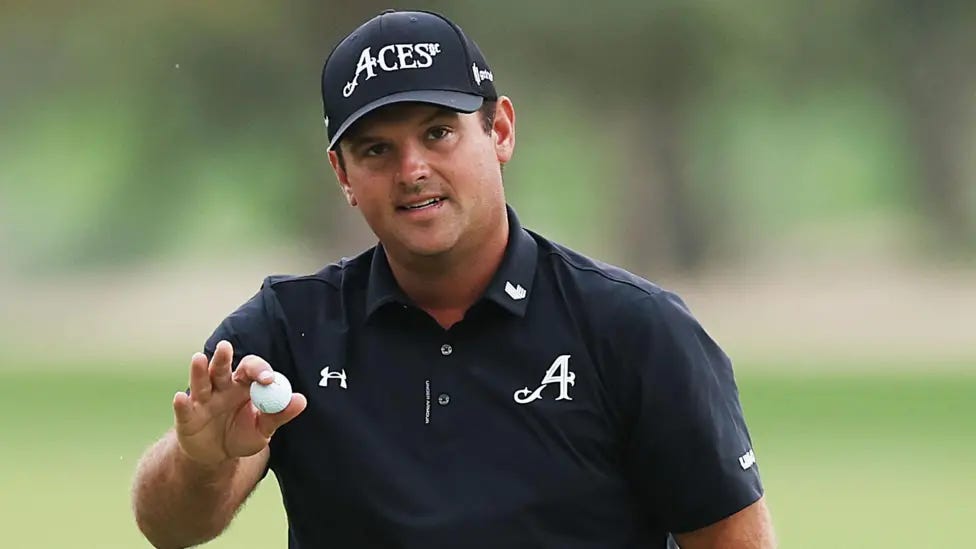
The Reed mechanics: not a “return” so much as a timetable
The PGA Tour statement is the key document.
Reed is seeking reinstatement for 2027, using past champion status.
Because he resigned his PGA Tour membership in 2022 before violating Tour regulations, the Tour says he can play as a non-member from 25 August 2026.
The Tour also flags what it wants fans and players to notice: returning members lose access to the Player Equity Program for years.
Reed’s own statement frames it as a values call, “tradition”, “born to play on the PGA Tour”, but the operational reality is simple: he’s chosen the PGA Tour ecosystem for 2027, with a possible on-ramp late summer 2026.
LIV’s statement is blunter. No tribute package. No, “we respect his decision”. Just: we could not come to terms. That is a negotiation ending, not a partnership ending.
Koepka was the precedent. Reed is the optics grenade.
Brooks Koepka’s return earlier this month is what made Reed plausible. It proved the PGA Tour is willing to create a structured exit from “unauthorised tournaments”, as long as the consequences hurt.
Koepka’s penalties, as reported across multiple outlets, are the framework:
No Player Equity Program payouts for years (and estimates of forfeited value in the tens of millions).
No 2026 FedExCup bonus pool eligibility.
A $5m charitable donation requirement.
Limits around access (including sponsor exemptions into certain top-tier events, per reporting).
Koepka’s move was the Tour saying: come back, but pay. Reed’s move is the same message, delivered with a more damaging subtext for LIV: you can leave, late, and the league has to explain it.
LIV’s late-contract problem: it is difficult to sell “franchises” with uncertainty
LIV is trying to look more like a mature league in 2026: 72 holes, expanded fields, more structured pathways, and more commercial polish.
And yet Reed’s situation has been a slow leak for days: he won in Dubai, said he wasn’t signed, despite all the signs beforehand suggesting he was, and then walked.
This is why the timing stings.
Team sport logic relies on continuity. LIV’s pitch is long-term team value. That becomes a harder sell when a marquee name is still not contracted close to opening week, especially when he has been front-and-centre in team branding and partner rollouts, including the 4Aces’ Under Armour announcement for 2026.
None of this means LIV is collapsing. But it does mean the league has a retention optics problem at the exact moment it is asking sponsors, broadcasters and fans to buy the “real league” argument.
The PGA Tour’s optics are not clean either
From Ponte Vedra’s view, this is a win: two high-profile defectors choosing the Tour again.
But there’s a tension the Tour can’t avoid: it spent years painting LIV as beyond the pale, then created a pathway back. The Tour tries to square that circle with “severe yet appropriate” consequences and eligibility gates.
Inside the locker room, the optics are touchier. Players who stayed will ask the obvious question: where is the reward for loyalty? The Tour’s answer is equity for the loyalists, and equity exclusion for the returnees.
That helps. It doesn’t erase the reality that the Tour has accepted what it used to deny: talent moves. Money talks. And the door can’t be welded shut.
The elephant in the room: Bryson
If you want the real read on where this goes, stop staring at Reed and look at Bryson DeChambeau.
He’s been linked with return rumours for months. He has publicly poured cold water on them before. But the more relevant recent line is this: DeChambeau said he has a contract “this year” and described the future as an “ever-evolving conversation”, while also saying he wouldn’t follow Koepka back before the PGA Tour’s early-February deadline.
That’s not a commitment. It’s a holding pattern.
The PGA Tour has also, per reporting, offered the same time-sensitive route to other LIV stars, including DeChambeau.
So here’s the question that matters for 2026 and beyond:
If Bryson stays, LIV can frame Reed as a one-off contract dispute.
If Bryson wobbles, LIV’s “teams are the future” message takes a direct hit.
Either way, Bryson is the league’s most marketable personality in the US ecosystem. Losing him would hurt more than losing almost anyone not named Rahm.
What this means for 2026 and beyond
1) We now have a transfer market
Not formal free agency, but a functional version:
LIV contracts become shorter, more flexible, and more incentive-heavy.
The PGA Tour’s return programme becomes a negotiating chip, not just a punishment tool.
2) DP World Tour becomes a bridge league again
Reed’s pathway explicitly includes the possibility of improving PGA Tour status via DPWT performance. That matters because it offers a credible competitive runway while players wait out dates and categories.
3) LIV will have to choose: stability or churn
More movement can be spun as “player choice”. But too much churn kills franchise storytelling. LIV’s commercial progress (team kits, bigger format, clearer entry routes) only pays off if fans believe rosters mean something year-to-year.
4) The PGA Tour will keep the price high
The Tour cannot allow a revolving door without undermining its own deterrent. Expect continued emphasis on lost equity, restricted access, and reputational friction, all designed to make “go to LIV, then come back” a minority strategy rather than the norm.
Par’s verdict
Reed and Koepka don’t prove LIV was a failure. They prove the market has matured.
Players now know two things at once:
LIV can pay life-changing money and offer a lighter weekly grind.
The PGA Tour, under pressure, has built a route back — with a bill attached.
The next chapter hinges on whether the biggest LIV personalities see that route as worth taking.
And that brings us back to Bryson. Watch his language. Watch his contract length. Watch whether “ever-evolving” becomes “extension signed”.
Because Reed isn’t the trend. He’s the proof of concept.
Confidence score: 7/10 that “LIV-to-PGA” becomes a recurring storyline in 2026–27; 4/10 that it becomes a flood. The Tour’s penalties are designed specifically to prevent that.