

The Breaking Point: Jon Rahm’s Collision Course with the DP World Tour...
Could It Rewrite Golf’s Legal Landscape?

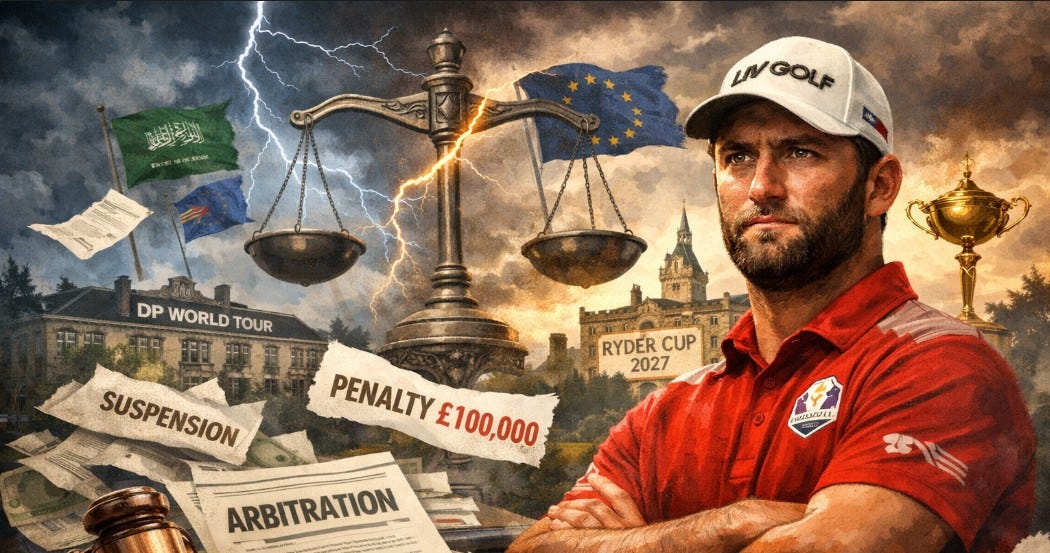
As the golfing world casts its eyes towards the 2027 Ryder Cup at Adare Manor, a massive legal storm is quietly brewing behind the doors of the DP World Tour’s Wentworth headquarters. At the centre of the tempest is Jon Rahm, a two-time major champion and the undeniable beating heart of the European Ryder Cup team. Rahm is currently locked in a high-stakes standoff with the DP World Tour (DPWT), appealing the mounting fines and suspensions levied against him for playing in conflicting LIV Golf events.
While other players, including his Ryder Cup teammate Tyrrell Hatton, have chosen to swallow their pride, pay the fines, and secure their Ryder Cup eligibility under a recently offered settlement, Rahm has dug his heels in. He is refusing to write the cheque and is taking the DPWT back to arbitration.
On the surface, this looks like a sequel to the 2023 arbitration case where the Tour successfully defended its right to punish defectors like Ian Poulter and Lee Westwood. But a closer look reveals that the landscape of professional golf has fundamentally shifted. Rahm’s impending arbitration is not a mere replay of 2023; it is a brand-new legal battleground with the potential to completely dismantle the DP World Tour’s disciplinary framework.
The 2023 Precedent: A Line in the Sand at Wentworth
To understand why Rahm’s case is so pivotal, we first have to look back at the precedent set in London in April 2023. When LIV Golf first launched, the DPWT used its “Conflicting Tournament Regulation” to deny release requests and subsequently slap players with unprecedented £100,000 fines per event.
A group of LIV defectors took the DPWT to an independent UK arbitration panel (Sport Resolutions), arguing that the fines were arbitrary, vindictive, and wildly disproportionate. How, they argued, could the Tour justify a £100,000 fine for skipping a standard DPWT event where the winner’s cheque was barely double that amount?
The arbitration panel, however, sided unequivocally with the DPWT. The three-person panel ruled that the Tour was a membership organisation with the legal right to enforce its own rules. More importantly, they ruled that the £100,000 fine was “reasonable and proportionate.” The judges recognised that the fine was not about replacing the prize money of the skipped tournament; it was about compensating the DPWT for the commercial damage caused by its biggest stars migrating to a billionaire-backed rival, which actively devalued the Tour’s broadcast rights and sponsorships.
In 2023, the ruling gave Chief Executive Keith Pelley (and now his successor, Guy Kinnings) a blank cheque to enforce their boundaries. But fast forward to 2026, and the context surrounding that ruling has been turned completely upside down.
The 2026 Landscape: A Whole New World
The primary weakness in the DPWT’s current stance is that the golf ecosystem of 2026 looks absolutely nothing like the one in 2023. Rahm’s legal team is stepping into arbitration armed with arguments that the Poulter-Westwood cohort could only have dreamt of.
The Legitimacy of LIV Golf
In 2023, LIV Golf was viewed legally and competitively as a rogue, unsanctioned disruptor. Today, the narrative has shifted dramatically. LIV is now an established, unavoidable entity. Its players have been granted pathways into the Majors by the USGA and the R&A, and the Official World Golf Ranking (OWGR) board has finally begun to recognise its competitive weight. Rahm’s lawyers will undoubtedly ask: How can the DPWT continue to treat participating in LIV events as a cardinal sin when the sport’s highest governing bodies, and the guardians of The Open Championship, have effectively legitimised the circuit?
The “Sofa vs. Competing” Argument
Rahm also brings a heavy dose of common sense to his defence: he never would have played the conflicting DPWT events in the first place. Prior to joining LIV, when Rahm played a full PGA Tour schedule, he routinely sat out the vast majority of regular DPWT events. From his perspective, the DPWT is suffering zero “commercial damage” from his absence at the Andalucía Masters, because he would have been sitting on his sofa in Arizona anyway. He is being penalised not for abandoning the European Tour, but simply for playing golf elsewhere.
The Hypocrisy of the PGA Tour Alliance
Perhaps the most glaring contradiction is the DPWT’s relationship with the PGA Tour. The PGA Tour now owns a 40% stake in European Tour Productions and subsidises the DPWT’s prize purses to the tune of tens of millions of pounds a year. Yet, the PGA Tour is actively engaged in negotiations with the Saudi Public Investment Fund (LIV’s backers) and has instituted “returning member” programmes for former defectors. If the DPWT’s primary financial underwriter is actively doing business with the “enemy,” the DPWT’s argument that LIV represents a catastrophic, existential threat that warrants draconian punishments begins to look incredibly flimsy.
The Tipping Point: When Does a Fine Become Extortion?
Despite the shifting landscape, the DPWT will lean heavily on the 2023 ruling. A contract is a contract, they will argue, and Rahm voluntarily renewed his membership knowing the rules. If you break the rules, you pay the penalty.
However, this brings us to the most critical, and potentially fatal, flaw in the DPWT’s legal strategy: the compounding nature of the fines. And this is where English contract law could blow the Tour’s entire defence out of the water.
Under English contract law, there is a very strict distinction between “liquidated damages” (a reasonable, pre-agreed estimate of financial loss) and a “penalty clause” (an arbitrary, punitive fine designed solely to punish the breaching party). Following landmark Supreme Court rulings like Cavendish Square Holding BV v Talal El Makdessi, a financial penalty for breaching a contract is only legally enforceable if it protects a “legitimate business interest” and is not “extravagant, exorbitant, or unconscionable.” If it crosses the line into being purely punitive, a UK arbitrator or judge will strike it down as an unenforceable penalty clause.
In 2023, the panel ruled that a few isolated £100,000 fines were a proportionate deterrent against a new, deep-pocketed rival. But today, the mathematics have spiralled out of control.
LIV Golf now operates a 14-event schedule. Under the DPWT’s current enforcement regime, a player like Rahm is being fined upwards of £1 million every single year.
Think about the absurdity of that arithmetic. The DPWT is essentially invoicing Rahm nearly £1.5 million annually just for the “privilege” of maintaining his membership so that he can fulfil his four-event minimum, play in the Spanish Open, and remain eligible for the Ryder Cup.
At what point does a deterrent become an extortion racket?
Rahm’s lawyers will argue that a £1 million plus, annual tax to remain a member in good standing is no longer protecting a legitimate business interest, it is a draconian measure designed to bankrupt players out of competing, or force them to buy their way into the Ryder Cup. If the DPWT’s revenues are currently stable (albeit heavily subsidised by the PGA Tour), they cannot possibly prove to a London arbitration panel that Rahm playing a LIV event in Adelaide caused them £100,000 worth of specific, calculable commercial damage that weekend.
A High-Stakes Game of Chicken
The DP World Tour is currently playing the most dangerous game of chicken in its history. By refusing to compromise with Rahm and forcing this to arbitration, they are betting their entire disciplinary structure on a single ruling.
If the arbitrator looks at the compounding £1 million plus, annual bill and decides, “Enough is enough, this is an illegal penalty clause under English law,” the dam will break. The DPWT will lose its only weapon to keep players from flocking to LIV, and every other fined player will have the legal precedent to demand their money back.
On the other hand, if Rahm loses, he faces an agonising choice: swallow his pride and write a massive cheque to an organisation he feels is extorting him, or refuse to pay and forfeit his right to represent Europe at Adare Manor in 2027. If he chooses the latter, he risks becoming the ultimate scapegoat for European golf fans if Team Europe loses the Cup on home soil.
The DPWT knows exactly how much the Ryder Cup means to these players, and they are using that leverage to its absolute limit. But as the fines pile up into the millions, the Tour must ask itself a terrifying question: what happens if the arbitrator decides that the ransom demand has finally gotten too high?